UAE lifts all air traffic restrictions introduced since Iran war

The United Arab Emirates has lifted all flight restrictions put in place since the start of the United States and Israel’s war on Iran, the country’s civil aviation authority has announced.

All air operations have returned to “normal status” in UAE airspace, the General Civil Aviation Authority said in a statement on Saturday.

“Our decision came following a comprehensive assessment of operational and security conditions, in coordination with the relevant authorities”, the aviation authority said in a post on X, adding that it would continue monitoring the situation.

The announcement marks a significant milestone for UAE hubs Dubai, home to the world’s busiest airport for international passengers, and Abu Dhabi, which have been operating under restrictions since late February.

The US-Israel war on Iran has caused major disruption to aviation across the Middle East, with Tehran’s retaliatory strikes on Gulf countries forcing the closure of large portions of the region’s airspace.

As well as dealing a blow to a region that is striving to lessen it economic dependence on fossil fuels, the upheaval has restricted the number of routes available to air carriers operating long-haul flights between Europe and Asia.

At least eight states announced full or partial airspace closures, including the UAE, Iraq, Jordan, Qatar, Bahrain, and Kuwait.

UAE carriers Emirates and flydubai temporarily halted all operations, while Etihad suspended all departures from Abu Dhabi.

More than 11,000 flights in and out of the region were cancelled in the opening days of the conflict, according to aviation data firm Cirium.

The UAE declared a “temporary and partial” closure of its airspace at the beginning of the conflict in late February, before announcing a gradual reopening in March.

During the UAE’s partial resumption of air traffic between March 1 and 12, the country’s airports handled 1.4 million passengers and recorded 7,839 air traffic movements, while its national carriers saw their operations recover to 44.6 percent of normal levels.

A Pakistan-brokered ceasefire last month brought the conflict to a halt, paving the way for Saturday’s announcement.

Signs of a broader regional aviation recovery are emerging.

Qatar Airways on Saturday separately confirmed that it would resume flights to three Iraqi cities from May 10, after previously announcing plans to serve more than 150 destinations across six continents from mid-June.

Source : aljazeera.com

If it flies, tax it: The growing costs of aviation in Africa

Air travel in Africa remains among the most expensive in the world — not for lack of demand, but because of the growing weight of taxes and charges imposed on the sector.

Across the continent, passengers are paying far more than the cost of flying itself. Industry data shows that a typical international departure from Africa attracts an average of 3.5 separate taxes and charges, amounting to about $68 per ticket, more than double what travellers pay in regions such as Europe and the Middle East.

In some countries, these levies can climb dramatically higher. Certain airports charge close to $300 in taxes and fees on a single ticket, significantly inflating the overall cost of travel.

A continent priced out of the skies

The cumulative effect is stark. Taxes and fees can account for over 35% of the total ticket price — and more than half of the cheapest base fares.

For many Africans, this effectively prices air travel out of reach, reinforcing the perception that flying is a luxury rather than a necessity. This is despite aviation playing a critical role in connecting a vast continent with limited rail and road alternatives.

The paradox is clear: demand for air travel is rising, yet affordability continues to lag behind.

Airlines squeezed by high operating costs

For airlines, the pressure is equally severe. African carriers operate in one of the most expensive aviation environments globally.

Taxes and charges alone are estimated to be 12% to 15% higher than the global average, while fuel costs are about 17% higher and navigation fees roughly 10% above international benchmarks.

These structural costs leave airlines with thin profit margins, limiting their ability to expand routes, increase frequency, or lower fares.

The result is a self-reinforcing cycle: high costs lead to high ticket prices, which suppress demand, which in turn constrains growth.

Fragmented skies, limited connectivity

Despite its size and population, Africa remains one of the least connected aviation markets globally. Only about 19% of routes within the continent are direct, forcing travellers into longer, more expensive journeys.

At the same time, regions with the highest taxes tend to record the lowest traffic volumes. West and Central Africa, for instance, account for just 23% of total air traffic, despite imposing some of the highest aviation charges.

The economic consequences extend beyond airlines. Expensive and limited connectivity affects tourism, trade, and investment — sectors heavily reliant on efficient air transport.

A revenue strategy with long-term costs

Governments across Africa have increasingly turned to aviation as a source of revenue, introducing or raising taxes to meet fiscal pressures.

But industry bodies warn this approach may be counterproductive. High taxation reduces passenger numbers, weakens airline performance, and ultimately limits the broader economic benefits aviation can generate.

Aviation already supports an estimated $72 billion in GDP and 6.8 million jobs across Africa, underscoring its role as a key economic enabler.

Reducing the cost of flying, analysts argue, would stimulate demand, increase connectivity, and unlock significantly greater economic returns.

Calls for reform

Pressure is mounting for governments to rethink their approach. Industry stakeholders are calling for:

  • Rationalisation of taxes and fees
  • Greater alignment with global aviation standards
  • Investment in efficient airport infrastructure
  • Policies that prioritise connectivity over short-term revenue

The argument is not to eliminate taxes altogether, but to strike a balance that allows the sector to grow sustainably.

The bottom line

Africa’s aviation market is one of the fastest-growing globally, with long-term passenger demand expected to rise steadily. Yet without structural reforms, that growth risks being constrained by the very policies meant to generate revenue.

For now, the reality remains unchanged: in Africa, if it flies, it is taxed — and often heavily.

source : theeastafrican.co.ke

What travel agents know that Google & AI don’t

You’ve got 47 tabs open. TripAdvisor, Booking.com, cruise comparison sites, and airline alerts. Your Notes app is overflowing with copied links and half-formed itineraries. Three hours in, you’re somehow more confused than when you started.

Sound familiar?

Today, most travellers book their own holidays. We’ve mastered the mechanics of online booking, but there’s a catch: a large majority still worry about making costly mistakes — choosing the wrong flight time or date, overpaying, ending up with questionable accommodation, or locking themselves into non-refundable deals they can’t use. That’s where a good travel agent quietly proves their worth.

Like the doorway you’d walk straight past

Search engines will point you to the obvious — iconic landmarks, top-rated attractions, and heavily reviewed experiences. But they rarely uncover the places that don’t advertise themselves well: the tucked-away, locally known, genuinely memorable spots that never trend online.

That kind of knowledge doesn’t come from algorithms. It comes from years of travelling, building relationships on the ground, and knowing which experiences are truly special — and which ones are simply well-marketed.

The scams your research might not catch

Even experienced travellers can fall for increasingly sophisticated online scams. A picture-perfect lodge, a polished website, convincing email exchanges — everything can look legitimate until it isn’t.

Without direct verification channels or industry networks, it’s difficult to spot the red flags. Some listings may represent properties that no longer exist, have changed ownership, or were never real to begin with.

Travel agents operate within trusted ecosystems. They have access to verified operators and tourism bodies, allowing them to confirm what’s real — and what isn’t — before money changes hands.

When curation beats endless options

The average traveller now spends hundreds of hours consuming travel content before making a booking. Ironically, more information often leads to more uncertainty.

At some point, endless choice becomes overwhelming. Reviews blur together. Recommendations conflict. Decision fatigue sets in.

This is where human curation matters. Instead of presenting more options, a travel agent filters them — tailoring choices to specific needs, whether that’s mobility considerations, medical requirements, dietary restrictions, or family logistics. These are nuances algorithms often overlook.

Your lifeline when things go wrong

Booking online works — until it doesn’t.

A missed connection, a cancelled flight, a non-refundable booking that suddenly needs to change. Hours spent on hold. Emails that go unanswered. Now imagine that situation unfolding during an actual emergency — extreme weather, political unrest, or unexpected disruptions abroad.

In those moments, having someone who can act on your behalf makes all the difference. While you focus on your immediate situation, they’re coordinating solutions — rebooking flights, securing refunds, arranging assistance — often faster than you could on your own.

Without that support, you’re navigating the chaos alone.

The extras that don’t show up in search results

Not every unforgettable travel moment can be searched for. Some of the best experiences are the ones you didn’t know to ask for.

A perfectly timed dinner with the best view in the city. A behind-the-scenes experience unavailable to the public. A surprise moment that turns a trip into a lifelong memory.

These details aren’t accidents. They’re the result of connections, foresight, and an understanding of what elevates a trip from ordinary to exceptional.

So, can you book everything yourself? Yes.

But the real question is whether you should.

Because beyond the convenience of clicking “book now,” there’s a layer of insight, protection, and personalization that technology hasn’t quite mastered — the kind that spots risks before they happen, finds what others miss, and steps in when things don’t go to plan.

Your browser tabs can wait.

Source: escape.com

African governments need to prioritise aviation for economic growth

The International Air Transport Association (IATA) has called on African governments to prioritise aviation as a strategic enabler of economic and social development, highlighting its role in supporting long-term growth across the continent.

Kamil Alawadhi, Regional Vice President for Africa and the Middle East at IATA, said: “Aviation is economic infrastructure for Africa. Its value lies in the long-term benefits it delivers. An aviation strategy focused on safety, cost-competitiveness, energy security/sustainability, and ease of doing business will create jobs, enable trade, support tourism, and further regional integration. The prosperity this generates will allow governments to push forward social and economic development more durably than any tax that might be collected from travelers.”

Speaking at the Focus Africa Conference in Addis Ababa, Ethiopia, IATA outlined a comprehensive aviation strategy built around four key pillars: safety, cost competitiveness, ease of doing business, and sustainability.

On safety, Africa has recorded progress, with the accident rate declining from 12.13 to 7.86 per million sectors between 2024 and 2025. However, this remains above the global average of 1.32 and is the highest among all regions. IATA called for increased implementation of ICAO Standards and Recommended Practices, improved publication of accident reports, and wider adoption of global safety audits to strengthen regulatory oversight and operational performance.

Cost competitiveness remains a significant challenge, with aviation-related taxes and charges in Africa approximately 15% higher than the global average. IATA highlighted the need to reverse increasing API-PNR charges, implement the ECOWAS decision to reduce aviation taxes and charges, and maintain residence-based corporate taxation for airlines to avoid double taxation and support cross-border operations.

Ease of doing business was identified as another critical area, particularly regarding the repatriation of airline revenues and visa policies. As of the end of March 2026, African countries accounted for USD 774 million in blocked airline funds globally. Algeria holds the largest share at USD 258 million, followed by the XAF Zone, Mozambique, Eritrea, and Angola.

“Given the scale of funds blocked in Algeria, urgent and decisive government action in Algeria is essential. But our efforts to engage with the Ministry of Trade and Export Promotion and the Central Bank have received little response, and airlines continue to face delays despite complying with burdensome requirements. In Algeria, and all locations where airlines are denied access to their revenues, governments must engage with the industry to find a sustainable solution or risk the consequences on connectivity,” said Kamil Alawadhi.

IATA also noted that nearly half of intra-African travel still requires visas before departure, limiting regional mobility and tourism growth. Markets that have eased visa requirements have experienced stronger demand and increased use of regional air services.

On sustainability and energy security, IATA highlighted opportunities linked to Sustainable Aviation Fuel (SAF) production. Sub-Saharan Africa has the potential to supply up to 106 million tonnes of SAF feedstock by 2050, primarily from agricultural residues, forestry waste, and municipal solid waste. The association also pointed to the potential for African countries to supply 57.6 million Eligible Emission Units under CORSIA. However, only a limited number of countries have taken initial steps to participate.

IATA emphasised that aligning sustainability strategies with global frameworks, alongside targeted investment in infrastructure and policy support, could enhance energy security, generate employment, and strengthen the region’s role in the global aviation value chain.

Source; traveldailynews.com

IATA launches pilot Billing & Settlement Plan in Somalia

The International Air Transport Association (IATA) has launched a trial run of its Billing and Settlement Plan (BSP) in Somalia, with a full rollout expected by the end of May 2026.

This move aligns with Somalia’s efforts to strengthen its aviation industry and improve international connectivity. Rising demand for air travel, driven by the global diaspora and expanding trade ties across Africa and the Middle East, has made improvements to financial and operational systems increasingly important.

The pilot program includes four travel agents and several airlines operating in Somalia, including Ethiopian Airlines. In May 2026, the BSP is expected to be open to all airlines and to over 300 travel agents in the country.

The BSP is a global system that streamlines financial transactions between airlines and IATA-accredited travel agents. It centralizes ticket sales reporting and payments, helping airlines manage revenue more efficiently, improve cash flow, and maintain strong financial oversight in line with established standards and local regulations. In 2025 alone, the system processed more than 700 million transactions across more than 180 countries, totaling 242 billion US dollars.

Somalia’s Minister of Transport and Civil Aviation, Mohamed Farah Nuh, characterized the initiative as a significant advancement in the country’s aviation development.

“Somalia stands at a pivotal moment of transformation in its aviation sector. Growing connectivity regionally and globally underpins our ambition to revitalize the economy of Somalia and position Mogadishu as a transport hub on the Horn of Africa. Despite decades of adversity, the federal government has made commendable strides in rebuilding and modernizing every aspect of its civil aviation system. This extends to putting in place financial systems to support the growth of air transport, which the opening of the BSP will provide,” said Mohamed Farah Nuh.

Kamil Alawadhi, IATA’s Regional Vice President for Africa and the Middle East, commended Somalia’s efforts toward modernization.

“We commend the steps taken by the Somali government to modernize and rebuild its aviation infrastructure. The government recognizes the significant economic benefits that air travel can deliver, and we are pleased to support them on that journey. Accelerating the implementation of secure, effective, and cost-efficient financial services is a key pillar of IATA’s Focus Africa initiative,” said Kamil Alawadhi.

Source: qazinform.com

Global air passenger demand up in March, with Africa leading, despite Gulf crisis – IATA

New international air passenger data from the International Air Transport Association (IATA) shows in numbers how sharply the U.S.-Israel war on Iran has impacted travel globally, showing that while global demand was up 2.1% from March, 2025, demand in the Middle East dropped 58.6%.

“Everybody’s watching what’s happening with jet fuel—both supply and pricing. On the supply side, over the next few months, we could see shortages in parts of the world with high dependence on supplies from the Gulf, especially Asia and Europe,” said IATA’s Director General, Willie Walsh. “And the extraordinarily high cost of jet fuel is increasingly being reflected in ticket prices.

“While this has not impacted March traffic or forward bookings to date, it remains to be seen at what point high prices could start to shift passenger behavior,” Walsh continued. “So far, the summer is shaping up to be a normally busy time for travel. That’s positive news, but airline resilience is being tested, and stabilizing the supply and price of fuel is crucial. In the meantime, regulators need to be prepared to grant airlines some flexibility on slots, considering the extraordinary circumstances of airspace capacity restrictions and potential fuel rationing.”

Global Metrics Show Uneven Growth

While revenue passenger kilometers (RPKs), which measure total air travel demand, were up 2.1%, total capacity decreased 1.7% due to the war. International travel demand fell 0.6%, with capacity down 6.2% from last March.

Airlines in the Middle East experienced a 60.8% drop in international air travel in March.

Global domestic demand fared well in March, increasing 6.5% year-over-year, with capacity up 5.6%.

Regional Stats

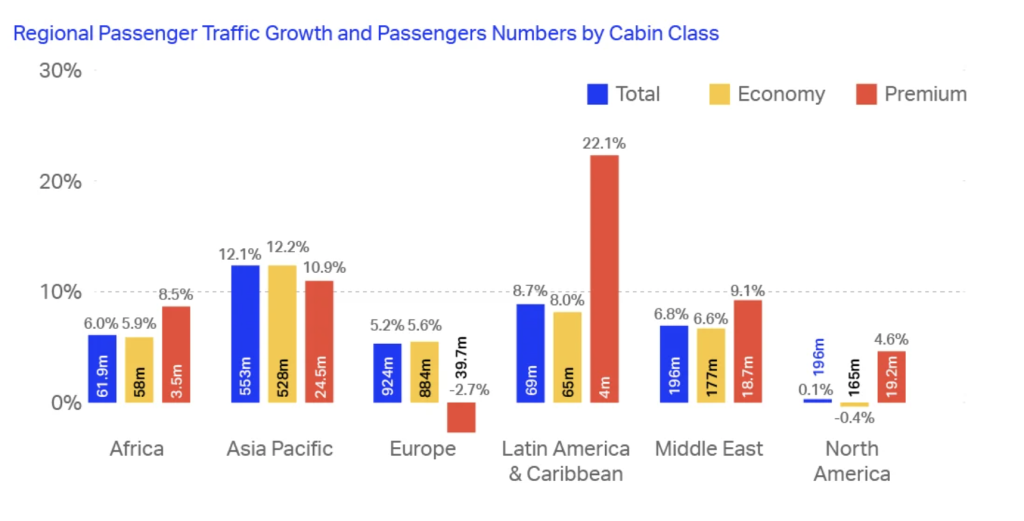
Regionally, growth is uneven. While passenger demand plummeted in the Middle East by nearly 60% due to the war, airlines in Africa saw a 20.6% increase in demand.

The Asia Pacific region saw an 11.5% growth; Europe saw a 7.5% growth; Latin America and the Caribbean experienced an 8.4% growth; and North America experienced a moderate 2.3% growth.

While global international travel demand fell for the first time since March 2021, regionally, most parts of the globe saw international travel demand rise.

Asia-Pacific airlines saw an 11.5% increase in demand from March 2025; European airlines celebrated a 7.7% increase; North American airlines saw a 3.7% increase; Latin American airlines welcomed a 12.1% increase; and African airlines celebrated a 19.2% increase in demand.

Domestic Travel Grows as War Creates Global Instability

In March, domestic travel demand finally outpaced international demand globally, increasing 6.5% year-over-year.

Domestic travel in Australia increased 8.8%; demand in China grew 13.7%; demand in Brazil increased 10.8%; and in the United States, it increased a moderate 1.4%.

Source : travelpulse.com

Build to Last… or Break Under Pressure? Inside Kenya’s Travel Industry Reality Check at KATA 2026 AGM & Convention

When Karanja Ndegwa, CEO of Jambojet, described strategy as “the art of war,” it felt less like a travel Industry meeting and more like a pre-match briefing. Minus the whistle, but with just as much at stake. In an industry defined by rising fuel costs, shifting fares, and constant disruption, the comparison lands a little too well.

And just like football, everyone has an opinion. It’s one thing to support Arsenal F.C when the passes are crisp, and the goals are flowing. It’s another when the season begins to ask harder questions. The travel industry, much like the league table, has a way of humbling even the most optimistic players.

An Industry Built on Movement and Constant Disruption

“Air travel is part and parcel of the economy,” noted Nicanor Sabula, CEO of the Kenya Association of Travel Agents (KATA), grounding the conversation in a simple but powerful truth. Travel does not just support economies, it mirrors them. When business slows, travel softens. When confidence rises, so do bookings.

Yet, if 2025 was anything to go by, that rhythm is anything but predictable.

For Jambojet, it was a year of strong performance, posting over 11% profit growth, a signal that low-cost travel in the region is not just viable, but thriving when conditions are right. Increased passenger numbers, route optimization, and a growing appetite for affordable domestic travel all played their part.

But the industry rarely allows a victory lap.

Barely months later, sudden fuel hikes forced a shift in strategy. Cost structures tightened. Decisions had to be made quickly. And once again, the industry returned to a familiar position. Adapting in real time.

It’s a pattern the travel Industry knows all too well. Progress followed by pressure.

“The Journey: Build to Last”

The 2026 KATA AGM & Convention’s theme feels less like a slogan and more like a quiet warning.

Build to last.

Not just to recover. Not just to grow. But to endure.

Because, as Karanja put it, this is fundamentally a crisis-led industry. External shocks are not rare disruptions; they are recurring features. Fuel volatility, currency fluctuations, global uncertainties, shifting demand patterns; each one capable of reshaping the landscape overnight.

So the question is no longer how to avoid disruption. It is how to design businesses that can absorb it.

Agility: The Industry’s New Currency

If there was one concept that anchored the discussion, it was agility. Not as a buzzword, but as a daily operational necessity.

For Jambojet, sustainability begins with a very direct question: Are we economically viable enough to still be here tomorrow?

It’s a refreshingly pragmatic take.

Before long-term sustainability goals, before industry-wide commitments, comes survival. And survival depends on the ability to move quickly; adjust routes, manage capacity, control costs, and respond to shifting demand without losing momentum.

Agility, in this sense, is not about speed alone. It is about precision under pressure.

And perhaps that’s where the “art of war” analogy begins to make sense. Strategy is no longer a fixed plan. It is a continuous process of recalibration.

Leadership Under Pressure and the Digital Shift

Beneath the headline conversations lies a deeper transformation, one that speaks to how the industry is being led.

Leadership today is less about long-term certainty and more about navigating constant ambiguity. Decisions are being made faster, often with incomplete information, and with higher stakes.

At the same time, digital transformation is quietly redefining how travel businesses operate. From booking systems to customer engagement, from data-driven pricing to operational efficiency, technology is no longer a support function; it is central to survival.

For travel agents, this shift is particularly significant. The traditional role is evolving into something more dynamic: part advisor, part technologist, part strategist. Those who can adapt will not only remain relevant, but essential.

Partnerships That Actually Work

One of the more practical takeaways from the discussions is the growing importance of partnerships that deliver real value, not just symbolic alignment.

In that context, Jambojet’s presence at the AGM is more than ceremonial.

As a platinum sponsor, the airline represents a model of how collaboration between carriers and travel agents can strengthen the entire ecosystem. By focusing on accessibility, affordability, and reliable connectivity, Jambojet continues to create opportunities for agents to expand their offerings and reach new segments of travellers.

It’s not just about filling seats. It’s about enabling movement.

And in a region where connectivity can directly influence economic participation, that role carries weight.

From Conversation to Action

What makes the KATA AGM & Convention 2026, set to take place from 4–6 June 2026 at PrideInn Paradise Beach Resort & Spa, particularly relevant is not just the discussions themselves, but what they represent.

This is where industry realities are acknowledged openly, where challenges are not dressed up, but dissected. Where strategies are tested against lived experience. And where ideas begin to take shape beyond theory.

The conversations around leadership, agility, sustainability, and digital transformation are not isolated themes. They are interconnected responses to a single reality: the industry must evolve continuously.

Football, Forums, and the Future

Of course, no serious conversation in this part of the world is complete without a little football banter. And somewhere between strategy talk and sustainability frameworks, the comparisons slipped in again.

Because in many ways, the travel industry is like football.

There are seasons of dominance and moments of doubt. Some strategies look brilliant on paper and fall apart under pressure. And there is always that unpredictable element that keeps everyone on edge.

The KATA AGM might just be the industry’s version of match-day analysis, where everyone gathers to debate, reflect, and prepare for what’s next.

The difference is that here, the stakes go far beyond winning. They are about survival, growth, and staying in the game.

As for Arsenal… well, only time will tell.

But for the travel industry, one thing is already clear: this is a journey defined not by smooth flights, but by how well we navigate turbulence and whether we are truly building to last.

By Felix Wakiuru

Ghana Introduces Revolutionary e-Visa System to Boost Tourism and Business Travel

The Government of Ghana has officially approved a landmark electronic visa (e-visa) policy, signaling a major overhaul of its migration system. The move, designed to position the West African nation as a premier hub for investment and international travel, will replace traditional in-person application processes with a streamlined digital platform beginning in May 2026.

The “revolutionary” system aims to eliminate the administrative hurdles that have historically slowed entry for business travelers and tourists, allowing applicants to secure travel authorization entirely online without visiting embassies or consulates.

A Gateway for Africa

A central pillar of the new policy is the introduction of a fee-free visa regime for all African travelers. Set to launch on May 25 to coincide with Africa Day, the initiative fulfills a long-standing pledge to promote Pan-African mobility. While African Union passport holders will still undergo a digital vetting process, the previous $150 fee for visas-on-arrival will be waived.

Government officials state that the move is inspired by the vision of deeper continental integration and aligns with the African Continental Free Trade Area (AfCFTA) framework. Ghana joins a growing list of nations—including Rwanda, Seychelles, and The Gambia—in offering high levels of accessibility to fellow Africans.

Enhanced Security Through Technology

Despite the shift toward openness, authorities emphasized that national security remains a top priority. The e-visa platform is not merely a payment portal but a sophisticated security tool integrated with:

  • API-PNR Systems: Advanced Passenger Information and Passenger Name Record systems will allow for real-time tracking of travelers.
  • International Databases: The platform will be linked to global security databases to conduct robust background checks before arrival.
  • Vetting Protocols: Consular officers will retain the ability to verify information and vet applicants digitally, ensuring that the “open door” policy does not compromise border integrity.

Economic and Tourism Outlook

The digital transition is expected to provide a significant boost to the “Beyond the Return” initiative, Ghana’s long-term strategy to attract the global African diaspora. By shortening processing times and offering preferential conditions to the diaspora, the government hopes to see a surge in high-value tourism and cultural exchange.

Aviation and hospitality sectors are already preparing for increased demand. Industry analysts suggest that the e-visa rollout, combined with “gratis” access for Africans, will likely lead to higher hotel occupancy rates and an increase in direct flights to Kotoka International Airport.

Reciprocity and Global Reach

While the policy offers specific benefits to African nations, the e-visa system will be available to travelers worldwide. Officials have indicated that a principle of reciprocity will apply to visa fees for non-African nations, with costs adjusted based on the treatment of Ghanaian nationals in those respective countries.

With Cabinet approval now secured, the Ghana Immigration Service and the Ministry of Foreign Affairs are in the final stages of technical implementation. As of late May, Ghana is poised to set a new “golden record” for travel accessibility in West Africa, transforming how the world connects with the “Black Star” of the continent.

Source: travelandtourworld.com

How Inclusive Tourism Is Becoming a Reality

A global shift in tourism policy is transforming how the travel industry approaches accessibility, moving beyond basic compliance toward a comprehensive model of “inclusive tourism.” New government mandates and industry-wide structural changes are increasingly ensuring that travelers with disabilities have access to the same experiences as their non-disabled counterparts.

According to recent industry data, the “Purple Pound”—a term referring to the spending power of disabled households—is becoming a critical economic driver. In response, international tourism boards and private operators are overhauling infrastructure to meet the needs of a demographic that has historically been underserved.

Governments worldwide are beginning to treat accessible tourism not as a niche requirement, but as a fundamental right. New legislative frameworks are being introduced to mandate “Universal Design” in public spaces, transport hubs, and hospitality venues. This approach ensures that environments are inherently accessible to all people, regardless of age, size, or ability, without the need for specialized adaptation.

From the implementation of tactile paving and audio-described museum tours to the mandatory installation of level-access boarding on public transit, these policies are bridging the gap between intention and reality.

The industry is moving away from the “accessible-on-request” model toward “Total Accessibility.” Key developments in this sector include:

  • Accessible Tour Operators: A new wave of travel firms is specializing in end-to-end accessible itineraries, vetting every hotel, restaurant, and transport link for barriers before a guest arrives.
  • Digital Transparency: Travel platforms are under increasing pressure to provide granular data on accessibility, such as door widths, bathroom grab-bar locations, and the availability of quiet spaces for neurodivergent travelers.
  • Infrastructure Integration: Major airlines and rail networks are investing in “seamless” transit technology, reducing the physical strain and logistical complexity often associated with traveling with mobility aids.

Practical Planning and Industry Evolution

As inclusive tourism becomes a reality, the focus is shifting toward “practical empowerment.” Industry experts note that the most successful destinations are those providing clear, reliable information that allows travelers to plan with confidence. This includes “sensory maps” for those with cognitive disabilities and detailed topographical guides for wheelchair users.

The evolution of the sector is also being driven by a change in perception. Rather than viewing accessibility as a “cost,” many leading tourism hubs now view it as a “competitive advantage.” Destinations that invest in inclusive infrastructure are seeing higher rates of return visits and longer stays from a demographic that values reliability and safety above all else.

While significant hurdles remain—particularly in the standardization of accessibility ratings across different countries—the trajectory of the global travel market is clear. As official government policies continue to align with practical planning tools, inclusive tourism is no longer a future goal but a present-day reality, reshaping the world’s most popular destinations into spaces that are truly open to everyone.

Source : travelandtourworld.com

Why last-minute flights cost so much (and when they don’t)

Booking late is usually more expensive because cheaper fare buckets sell out early, leaving only higher-priced seats available. However, prices can sometimes drop if demand is low and airlines need to fill space. It’s a dynamic system where timing and flexibility matter.

If you’ve ever searched for a flight a few days before departure and rather baulked at the price, you’re not imagining it. Last-minute tickets are often significantly more expensive than those booked weeks or months beforehand.

But it’s not just airlines trying their luck with higher prices (although it might feel like it). There’s a fairly structured system behind it.

How do airlines price last-minute seats?

Due to dynamic pricing, airlines don’t set a single fixed price for a flight. Instead, each aircraft is divided into “fare buckets,” which are basically tiers of seats sold at different prices.

The cheapest seats are released first, often months in advance, and they gradually sell out as demand builds.

As the departure date gets closer, those lower-priced buckets disappear. What’s left tends to be higher-fare inventory. So by the time you’re booking last minute, you’re not seeing a “penalty price” as such – you’re seeing what’s actually still available.

It’s a system designed around yield management, where airlines try to maximise revenue across every seat.

According to the International Air Transport Association (IATA), Global passenger load factor reached a record high of 83.6% in 2025. But even in strong years, roughly 16-17% of seats are empty on average globally, costing airlines big money. It can also be a factor in whether a route lives or dies.

Essentially, a half-empty plane is a loss, but a fully booked plane with well-distributed fares is ideal. Last-minute pricing reflects the assumption that remaining seats are more valuable because supply is limited and urgency is higher.

Why late bookings are often business-driven

Another major factor is who is booking late. A large percentage of last-minute passengers are business travellers, emergency flyers, or people with inflexible schedules. These passengers are less worried about the price because they’re travelling out of necessity rather than choice.

Airlines know this. So as departure approaches, pricing models increasingly reflect demand from this group. Leisure travellers, who tend to book early to get the cheaper fares, are largely out of the equation by that point.

In short, it’s not just scarcity of seats driving prices up, but also the type of demand left in the system.

When last-minute flights don’t cost a fortune

Despite the general rule, there are plenty of exceptions. If a flight isn’t selling well, airlines may, in fact, drop prices close to departure to fill empty seats. It’s not ideal for them, but a discounted seat is still better than an empty one.

This is most common on less popular routes, off-peak travel days, or during periods of lower demand. Examples might be midweek flights or routes between secondary airports.

There’s also the occasional “flash” situation where prices dip briefly because of system updates or competition between airlines reacting to each other in real time.

Low-cost airlines can also behave differently. While they still use dynamic pricing, their models sometimes lead to sudden price drops if loads are low. It’s unpredictable, but not unheard of.

Timing, flexibility and luck

Ultimately, last-minute pricing is less about a single rule and more about probability. If demand is high, prices rise. If demand is less, prices can fall even at the eleventh hour. AI pricing is also being added to the mix.

Flexibility is the biggest factor travellers can control. Being open to different airports, departure times, or even shifting travel by a day or two can dramatically change what’s available.

The frustrating part is that there’s no perfect formula. Two flights on the same route can be completely different depending on bookings, seasonality and airline strategy.

So while last-minute flights are usually expensive, they’re not always the worst deal. Passengers just have to be willing to navigate a system that’s constantly moving. And sometimes that’s simply down to luck rather than judgement.

Source : aerospaceglobalnews