
Global air travel continued its recovery in 2025, with the latest World Air Transport Statistics (WATS) released by the International Air Transport Association (IATA) revealing rising passenger demand, growing premium travel, expanding airline fleets and increasing opportunities for the global tourism and travel industry.
The annual report, which compiles operational data from more than 1,300 airlines worldwide, paints a picture of an aviation sector that is not only recovering but evolving to meet changing passenger preferences and growing international demand.
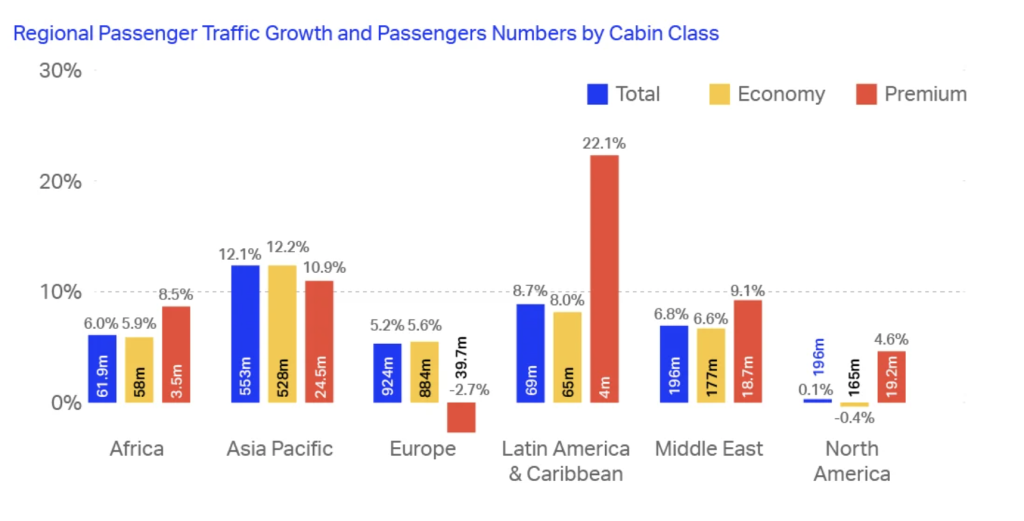
One of the standout findings is the continued growth of premium-class travel. International business and first-class passengers reached 109.7 million in 2025, representing a 4.5 per cent increase over the previous year. Premium travellers accounted for 5.5 per cent of all international passengers, reflecting the sustained demand for higher-end travel experiences despite global economic uncertainty.
Europe remained the world’s largest premium travel market with 39.7 million premium passengers, while North America and the Middle East recorded the highest proportion of premium travellers relative to their total passenger traffic. Latin America experienced the fastest growth, with premium passenger numbers rising by an impressive 22.1 per cent.
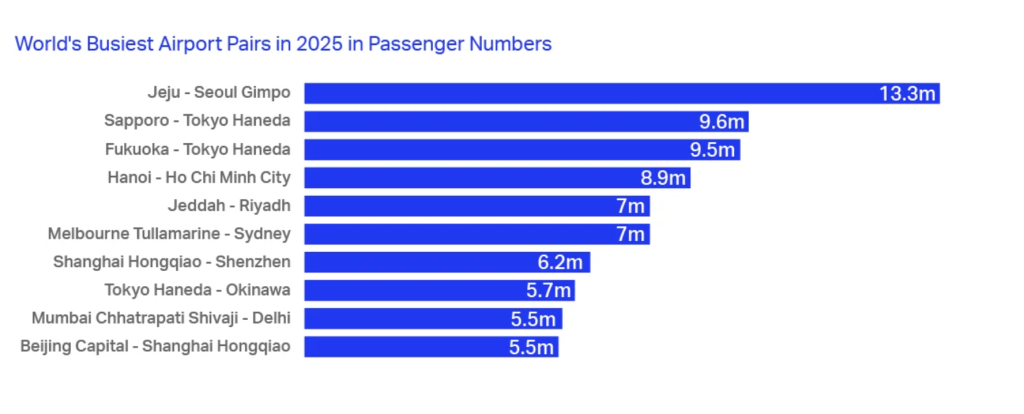
The report also highlights the growing importance of Asia-Pacific as the world’s busiest aviation region. The domestic route between Jeju International Airport and Seoul’s Gimpo International Airport retained its position as the world’s busiest airport pair, carrying 13.3 million passengers during the year. Remarkably, all ten of the world’s busiest airport pairs were domestic routes, underlining the strength of internal travel markets.
In Africa, the busiest air corridor remained the route linking Cape Town International Airport and Johannesburg’s OR Tambo International Airport, which handled 3.4 million passengers during 2025. The figures reflect the continued recovery of intra-African travel as airlines expand regional connectivity.
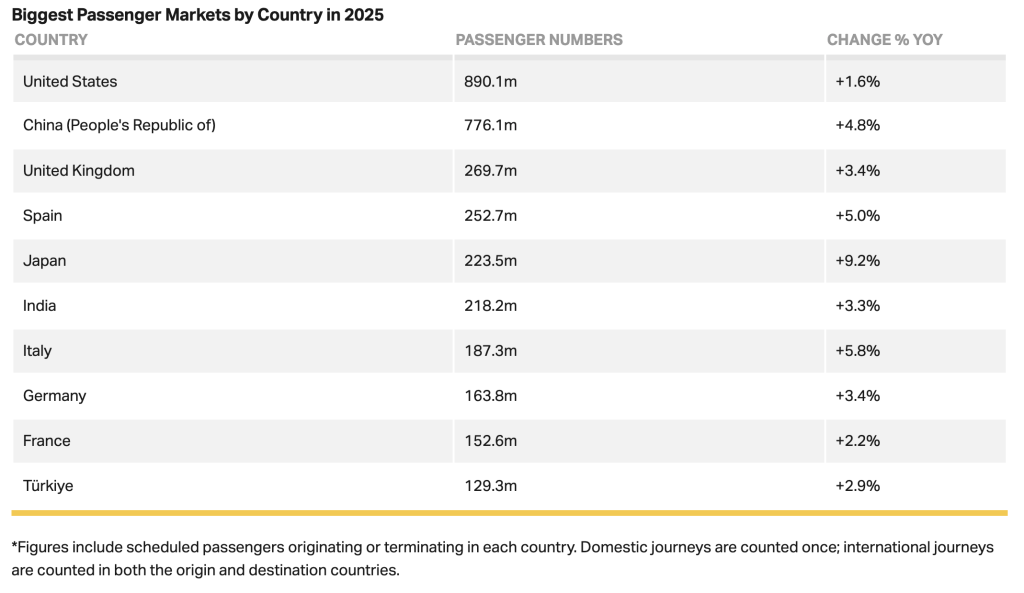
The United States maintained its position as the world’s largest aviation market, recording 890.1 million passengers during the year, followed by China with 776.1 million passengers. While the US remained the largest market, its annual growth rate of 1.6 per cent was the slowest among the world’s ten largest passenger markets.
Some of the strongest growth came from emerging aviation markets. Kazakhstan recorded an impressive 40 per cent increase in passenger traffic to 18.1 million travellers, while Uzbekistan and Vietnam also posted double-digit growth, demonstrating the rapid expansion of air travel across Central and Southeast Asia.
The report also illustrates how airlines continue modernising their fleets to improve efficiency and reduce operating costs. The Boeing 737 remained the world’s most frequently operated aircraft family with 10.8 million flights in 2025, followed by the Airbus A320 and Airbus A321.
Among long-haul aircraft, airlines increasingly favoured newer-generation models. Operations involving the Boeing 787 Dreamliner rose by 40.8 per cent compared to 2019 levels, while flights operated by the Airbus A350 more than doubled, increasing by 117.4 per cent over the same period. In contrast, the iconic Airbus A380 continued its gradual decline, operating 24.4 per cent fewer flights than before the pandemic.
For the travel industry, the latest statistics reinforce growing optimism about the future of global aviation. Rising passenger numbers, expanding premium travel and continued investment in modern aircraft point to increasing confidence among airlines and travellers alike.
The findings also present encouraging opportunities for travel agents and tourism stakeholders. Higher passenger volumes, expanding airline capacity and stronger international connectivity create greater potential for leisure travel, corporate travel, destination marketing and packaged tourism products.
As airlines continue investing in larger fleets and more efficient aircraft while passengers increasingly return to the skies, the latest IATA data suggests that global aviation has moved beyond recovery and is entering a new phase of sustained growth, driven by stronger demand, expanding networks and renewed confidence in international travel.
Source: breakingtravelnews.com