

Every leader has a signature. Some inspire through speeches. Others through bold declarations.
Dr. Joseph Kithitu has built his reputation asking questions.
“Take these numbers. Relate them to your business.” – It has become one of the defining lines of his leadership.
When addressing travel agents at industry forums, the Chairman of the Kenya Association of Travel Agents (KATA) has developed a habit of turning statistics into strategy sessions. BSP sales. Profit. Loss. Passenger trends. Industry performance.
Many leaders stop there. The numbers speak for themselves.

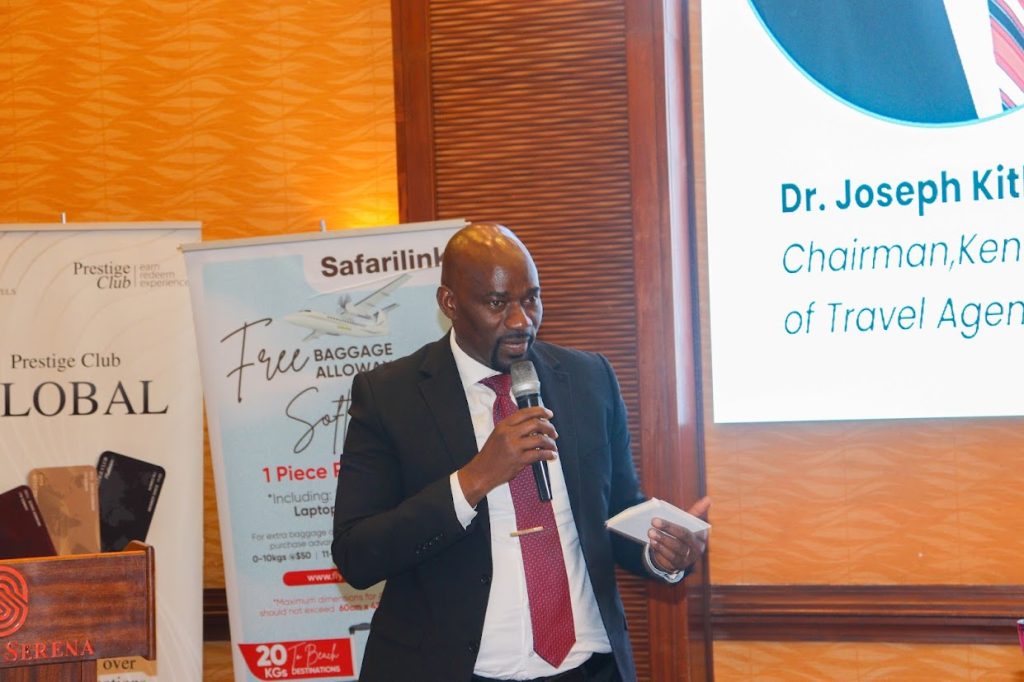
Dr. Kithitu is rarely interested in applause. Instead, he challenges the room. “Take these numbers. Relate them to your business. Are you keeping pace or are you being left behind?”
Suddenly, the presentation is no longer about Kenya’s travel industry. It becomes about every business owner in the room.
It is a deceptively simple leadership style. One that refuses to allow success to become complacency. Statistics are never the destination. They are the starting point for asking harder questions, challenging assumptions, and encouraging businesses to evolve.
Many view figures as a representation of growth. Dr. Kithitu sees something else.
A responsibility. To him, Industry growth means very little if individual businesses are not growing alongside it.
This week, his philosophy received regional recognition.
Meeting during the 2026 AESATA Travel Agents’ Conference in Livingstone, Zambia, the Board of the Association of Eastern and Southern Africa Travel Agents (AESATA) elected Dr. Joseph Kithitu as its new President, succeeding Tanzania’s Moustafa Khataw.
For many, the announcement was a moment of celebration. For those who have watched KATA’s transformation over the past few years, it felt more like the next logical chapter.
Strong industries are built on strong institutions.
Few people understand that better than Dr. Kithitu.
Long before assuming regional leadership, he had already begun reshaping KATA from a traditional membership organisation into an institution whose influence increasingly extends beyond its membership.
The results are difficult to ignore.
Over the past four years, KATA’s membership has grown by more than 70 per cent, transforming it into one of the country’s most representative travel industry associations. Growth on that scale reflects more than recruitment. It reflects confidence. Confidence that the Association is advocating effectively, creating opportunities for members and ensuring that travel agents have a seat at the tables where critical decisions are made.
And that is perhaps where Dr. Kithitu’s greatest impact has been felt.
Influence.
Under his stewardship, KATA has steadily positioned itself where the industry’s most important conversations happen.
The Association secured representation on the National Air Transport Facilitation Committee (NATFC), giving travel agents a voice in discussions shaping Kenya’s aviation sector. Through CEO Nicanor Sabula’s appointment to the Tourism Regulatory Authority (TRA) Board, KATA strengthened its contribution to tourism policy and regulation.
Regionally, the Association has remained actively engaged in the IATA Agency Programme Joint Council (APJC), working alongside counterpart associations in Uganda and Tanzania to ensure East African travel agents remain represented as airline distribution undergoes its biggest transformation in decades.
Internationally, Dr. Kithitu serves on the Board of the United Federation of Travel Agents’ Associations (UFTAA), one of the world’s most influential bodies representing travel agents. His involvement at the global level has given him a front-row seat to the issues reshaping international travel – from airline distribution and technology adoption to advocacy and professional standards- an experience that now naturally feeds into his regional leadership at AESATA.
None of those milestones happened overnight.
Together, they tell the story of a chairman who has consistently believed that influence is earned by being present where decisions are made.
That influence has already translated into tangible results for the industry. KATA successfully petitioned the Government to withdraw a proposal to introduce a 16 per cent Value Added Tax (VAT) on air ticketing services. Had it been implemented, the tax would have significantly increased the cost of ticketing services, placing additional financial pressure on travellers and travel agencies alike. The reversal was widely viewed as one of KATA’s most significant advocacy victories, demonstrating the Association’s ability not only to participate in policy discussions but to influence their outcome.
But advocacy alone has never been enough.
Dr. Kithitu has repeatedly argued that the future competitiveness of travel businesses will depend on their willingness to evolve. As artificial intelligence, automation and New Distribution Capability (NDC) continue to reshape the global travel landscape, KATA has consistently encouraged members not to fear technology but to embrace it.
Under his leadership, Industry meetings have quietly become important strategy forums. They begin with numbers. They end with conversations. Travel agency owners openly debate market realities. They challenge one another. They discuss technology, profitability, changing traveller behaviour and the future of the profession. These conversations continue inside boardrooms across the country. Perhaps that explains why KATA today is increasingly viewed not merely as an association, but as an institution helping shape the future of Kenya’s travel industry.
Dr. Kithitu’s own journey reflects that same blend of financial discipline and industry leadership. A holder of a PhD in Finance, Certified Public Accountant (CPA) and Certified Secretary, he spent more than two decades in senior finance before rising to become Managing Director of Hemingways Travel. Those who have worked with him often note that while his background is finance, his leadership has always been about people.
Numbers matter. Evidence matters. But only if they change behaviour.
That mindset now moves onto a much larger stage.
AESATA brings together 13 national travel agent associations from Botswana, Comoros, Ethiopia, Kenya, Malawi, Mauritius, Rwanda, Somalia, South Africa, Tanzania, Uganda, Zambia and Zimbabwe. Collectively, they represent thousands of travel professionals working to address many of the same challenges, including fragmented air connectivity, evolving airline distribution models, rapid technological disruption, changing consumer expectations and the need for stronger regional collaboration.






Africa’s travel industry stands at an important crossroads.
The African Continental Free Trade Area (AfCFTA) is creating new opportunities for commerce. Momentum behind the Single African Air Transport Market (SAATM) continues to grow. Governments are increasingly recognising tourism as a driver of economic development.
Yet barriers remain.
High airfares. Restrictive visa regimes. Limited connectivity. Uneven technology adoption.
No single country can solve those challenges alone. That is precisely why AESATA matters.
Its role is to bring countries together, build consensus, strengthen advocacy and ensure that travel agents remain central to shaping Africa’s tourism future.

For Kenya, Dr. Kithitu’s election represents far more than national pride. It places the country’s travel industry at the centre of regional conversations on aviation, tourism policy, technology adoption and professional standards. It strengthens Kenya’s voice in discussions that will determine how Eastern and Southern Africa travels, trades and grows over the coming years.
For AESATA, it brings a leader whose track record has been defined not by grand pronouncements, but by deliberate institution-building. By asking difficult questions. By challenging businesses to think differently. By measuring success not simply through industry performance, but through the progress of individual businesses.
Perhaps that is why one sentence continues to define his leadership.
“Take these numbers. Relate them to your business.”
It is a lesson that extends well beyond balance sheets. It is about refusing to confuse industry growth with personal progress. It is about turning opportunity into action.
And as Dr. Joseph Kithitu assumes the presidency of AESATA, it is a philosophy that now has the opportunity to shape not only Kenya’s travel industry, but the future of travel across Eastern and Southern Africa.