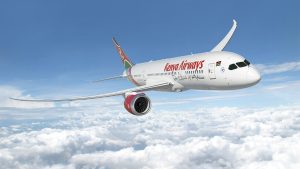

Kenya Airways has unveiled an ambitious decade-long expansion strategy to more than triple its fleet to 100 aircraft by 2035, signalling a major push to rebuild its global footprint following years of operational restructuring.
The strategy, announced during the airline’s annual agency awards ceremony in Nairobi on Wednesday, July 29, 2026, coincides with the return of its largest passenger aircraft – a 400-seat Boeing 777 wide-body – to active service on key international long-haul routes.
Under the new roadmap, the national carrier aims to increase its active fleet from 32 aircraft today to 67 by 2030, before reaching 100 aircraft by 2035.
The expansion is designed to support a projected surge in passenger traffic, with annual passenger volumes expected to grow from 5.2 million today to 9 million by the end of the decade.
The announcement comes on the heels of a critical operational milestone: on July 17, Kenya Airways reintroduced its flagship Boeing 777-300ER onto its high-density Nairobi-to-London Heathrow route after a long absence.
The move significantly boosts passenger seat capacity and belly-hold cargo volume between East Africa and Europe during the peak summer travel season.
Speaking to travel trade partners and industry stakeholders in Nairobi, Captain George Kamal, Acting Group Managing Director and Chief Executive Officer of Kenya Airways, emphasised that the airline’s long-term transformation relies heavily on expanding both its distribution network and fleet capacity as it approaches its 50th anniversary.
“As Kenya Airways approaches our 50-year milestone, our future success will continue to be built through strong relationships and shared success with the travel trade,” Captain Kamal said, noting that third-party travel agencies generate roughly 60 per cent of the airline’s passenger revenue.
“Travel trade partners are our largest distribution channel in Kenya, and we see our growth and yours as one journey.”
The fleet expansion follows an intensive effort by the SkyTeam alliance carrier to restore stability and clear heavy scheduled maintenance backlogs across its existing Boeing 787 Dreamliner fleet.
Airline executives noted that rebuilding capacity remains vital to defending market share against regional competitors across major corridors connecting Africa to Europe, Asia, and the Americas.
Julius Thairu, Kenya Airways’ Chief Commercial and Customer Officer, highlighted that scaling the network goes hand in hand with expanding commercial partnerships.
“This event is a statement of intent that we value your contribution, and we are committed to growing with you in a way that is practical, respectful, and commercially meaningful,” Thairu said.
Industry analysts view the 100-aircraft ambition as a bold statement of intent for the carrier, which operates out of its hub at Jomo Kenyatta International Airport in Nairobi.
If realised, the expanded fleet will position Kenya Airways as one of the largest passenger and cargo operators in Sub-Saharan Africa, reinforcing Nairobi’s position as a primary aviation hub for the continent.
Source: peopledaily. digital