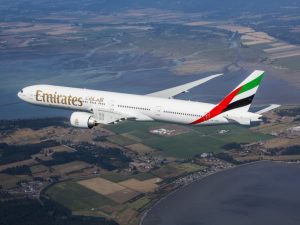

Kenya travel connectivity has been significantly strengthened as Emirates launches a third daily Dubai–Nairobi service, driven by rising passenger demand, stronger tourism flows, and increased global transit traffic, resulting in a major capacity expansion to 21 weekly Boeing 777 flights between the two cities.
This expansion positions Nairobi as one of East Africa’s most important aviation gateways, with enhanced connectivity to global destinations through Dubai’s long-haul hub network.
Kenya travel connectivity has been significantly upgraded as Emirates introduces a third daily Dubai–Nairobi service, increasing total operations to 21 weekly flights to support rising passenger demand and global transit flows.
This expansion marks a major structural shift in East Africa’s aviation landscape, turning Nairobi into one of the most frequently served African destinations in the Emirates network and reinforcing Dubai as a dominant intercontinental hub.
Strategic Network Expansion Reshapes Kenya–Dubai Aviation Corridor
The introduction of a third daily frequency has transformed the Dubai–Nairobi route from a high-demand dual-daily operation into a triple-wave daily network system.
Under the expanded schedule, Emirates now operates up to 21 weekly flights in each direction, significantly increasing seat capacity and improving flexibility for both business and leisure travellers.
The route is served by Boeing 777 aircraft, ensuring consistent long-haul performance and high passenger capacity across all daily rotations.
This expansion strengthens connectivity between Kenya and the United Arab Emirates while offering seamless onward access to Europe, Asia, and the Americas through Dubai.
Triple Daily Flight Structure Creates High-Frequency Travel Network
The upgraded schedule is built around three distinct daily operational waves, designed to maximise connectivity and optimise passenger flow.
The morning wave supports early departures from Nairobi and arrival into Dubai’s morning bank, allowing fast connections into Europe and Asia.
The midday wave balances demand between leisure and corporate traffic, ensuring smooth distribution of passenger volumes across the day.
The evening wave, introduced with the third daily service, enhances overnight connectivity and strengthens long-haul transfer options via Dubai International Airport.
This structured system transforms Nairobi into a high-frequency aviation gateway, aligned with global hub-and-spoke network efficiency.
EK717 and EK718 Form the Backbone of the Expanded Operation
A key component of the expanded network is the EK717/EK718 rotation, which plays a central role in early morning connectivity.
The EK717 service from Dubai to Nairobi typically operates in the early hours, arriving in Kenya during the morning, enabling passengers to begin business activities the same day.
The return EK718 flight from Nairobi to Dubai feeds directly into Emirates’ global departure banks, connecting passengers onward to hundreds of destinations.
This pairing is strategically designed to maximise aircraft utilisation and ensure smooth integration with global connection waves at Dubai International Airport.
Boeing 777 Deployment Enhances Capacity and Operational Efficiency
All Nairobi services are operated using the Boeing 777, a wide-body aircraft known for its long-range capability and high passenger capacity.
The aircraft’s configuration allows Emirates to efficiently manage both premium and economy demand while maintaining consistent service quality across all three daily frequencies.
Each rotation covers a flight duration of approximately five hours, ensuring stable scheduling and predictable connectivity patterns.
The use of a single aircraft type across all frequencies simplifies operations, enhances reliability, and supports rapid scaling of capacity during peak travel seasons.
Nairobi Strengthens Position as a Leading African Aviation Gateway
The expansion elevates Nairobi into one of the most intensively served destinations in Africa within the Emirates global network.
With 21 weekly flights, Nairobi now benefits from near-continuous connectivity to Dubai, reducing waiting times and improving transit efficiency for international passengers.
This enhanced access supports Kenya’s growing role as a tourism hub, particularly for safari travel, coastal holidays, and business tourism.
It also strengthens Nairobi’s position as a regional connector for East and Central Africa, linking surrounding markets into global aviation flows.
Tourism and Business Demand Drive Expansion Strategy
The increased flight frequency is closely tied to rising demand across multiple travel segments.
Kenya’s tourism sector continues to attract international visitors drawn to wildlife reserves, national parks, and coastal destinations.
At the same time, business travel between East Africa and the Gulf region has expanded due to growing trade, investment, and infrastructure development.
The additional capacity allows Emirates to better serve these combined demand streams while maintaining schedule flexibility across all travel classes.
Cargo transport also benefits, with increased belly-hold capacity supporting exports such as fresh produce, flowers, and perishable goods from Kenya to global markets.
Dubai Hub Integration Unlocks Global Connectivity for Kenya
A key advantage of the expanded Nairobi schedule is its integration with Dubai’s global hub system.
Passengers travelling from Kenya can now connect efficiently to more than 140 international destinations via Dubai International Airport.
The schedule is aligned with multiple daily wave structures in Dubai, including Europe-bound morning departures, Asia-Pacific midday flights, and long-haul evening services.
This ensures that Nairobi is fully embedded within a high-performance global network, reducing layover times and improving travel convenience for passengers.
Aviation Impact Strengthens Kenya’s Global Travel Position
The expansion reflects broader changes in global aviation, where high-frequency long-haul routes are increasingly used to optimise connectivity and passenger flow.
Kenya benefits directly from this shift, as increased capacity improves inbound tourism potential and strengthens outbound travel opportunities for Kenyan residents.
The route also enhances competitiveness among African aviation gateways, positioning Nairobi alongside leading hubs in Johannesburg and Cairo in terms of international connectivity strength.
The result is a more integrated travel ecosystem linking East Africa to global markets through Dubai’s central aviation corridor.
The expansion of Emirates’ Dubai–Nairobi service to 21 weekly flights represents a major milestone in East Africa’s aviation development.
With a triple daily Boeing 777 operation, structured wave scheduling, and deep integration into Dubai’s global hub system, Nairobi has been transformed into a high-frequency international gateway.
Kenya travel connectivity has been significantly strengthened as Emirates launches a third daily Dubai–Nairobi service, increasing operations to 21 weekly Boeing 777 flights due to rising passenger demand and stronger global transit traffic.
This development not only enhances tourism and business travel but also strengthens Kenya’s position in the global aviation network, marking a new phase of connectivity, capacity, and international reach.
Source: travelandtourworld.com