

As artificial intelligence rapidly transforms the global travel industry, the 2026 Kenya Association of Travel Agents AGM & Convention is positioning itself around a central question facing the sector: how do travel businesses build sustainable, future-ready companies in an increasingly digital world?
That conversation sits at the heart of this year’s theme, “The Journey: Build to Last.”
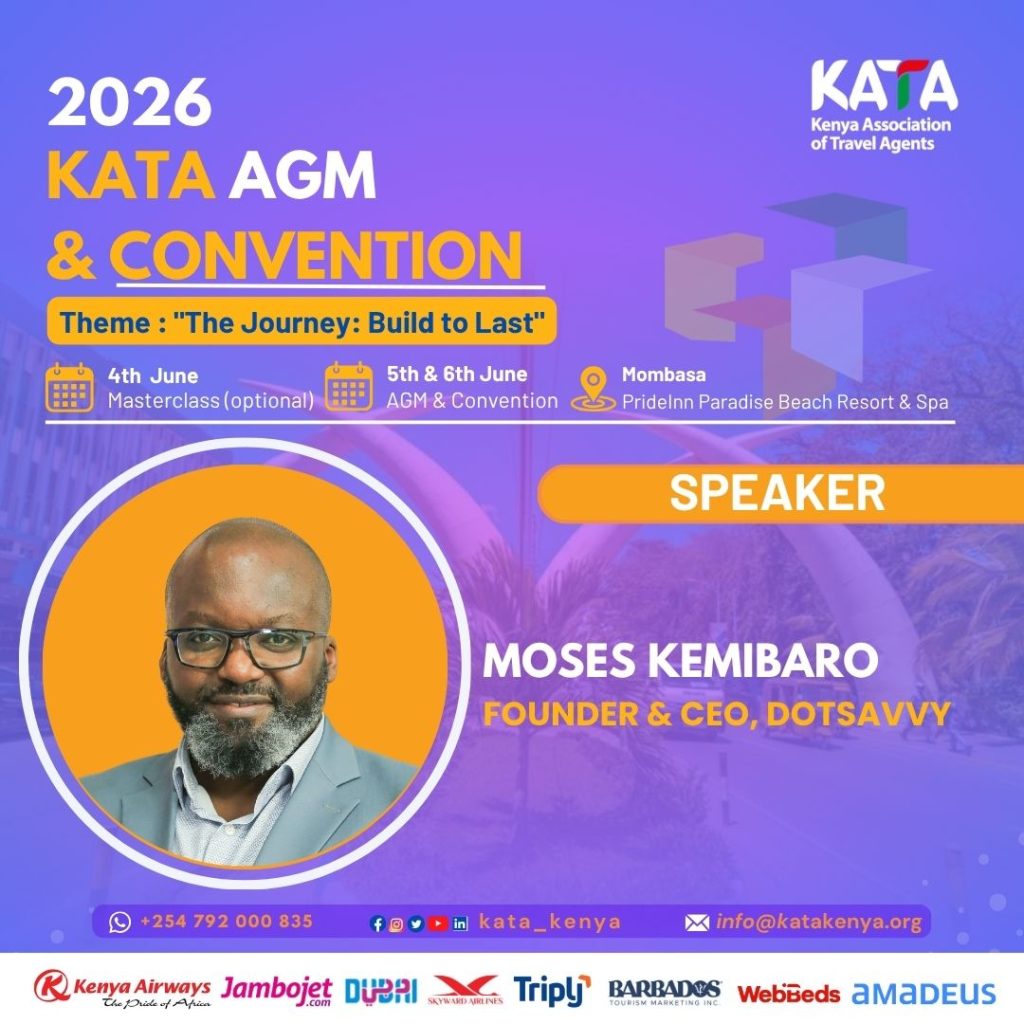
Set for June 5 and 6 at PrideInn Paradise Beach Resort & Spa, the convention will be preceded by an optional masterclass on June 4 focused on Digital Marketing in an AI Era, reflecting the growing urgency for travel businesses to adapt to technology-driven disruption.
The masterclass comes at a time when artificial intelligence is reshaping nearly every layer of the travel ecosystem. Airlines are using AI-powered pricing systems and predictive analytics, hotels are investing in automated customer engagement tools, and online travel platforms are increasingly relying on machine learning to personalize recommendations and influence consumer choices.
Globally, industry estimates show that more than 80% of travel companies are already investing in or piloting AI technologies aimed at improving marketing efficiency, customer targeting, and operational performance.
For travel agents, the shift is becoming impossible to ignore.
Today’s traveller can generate itineraries, compare destinations, receive personalized recommendations, and access travel information within seconds through AI-powered platforms. In such an environment, traditional travel businesses are under growing pressure to evolve beyond conventional sales models.
Industry analysts estimate that AI-driven personalization can improve marketing conversion rates by as much as 30%, while significantly lowering customer acquisition costs.
For African travel businesses, however, the challenge goes beyond adopting new tools. The larger question is whether local operators can remain visible and competitive in a marketplace increasingly controlled by algorithms, automation, and data-driven consumer engagement.
That reality is expected to define much of the discussion at the KATA masterclass, which will explore how businesses can leverage AI, digital marketing strategies, and modern data tools to improve customer engagement and long-term sustainability.
The session will be led by Moses Kemibaro, founder and CEO of Dotsavvy, whose work focuses on digital transformation and technology strategy across African markets.
The broader AGM itself is also continuing to grow in scale and influence.
Following strong participation in 2025, the 2026 convention is expected to attract more than 400 delegates from over 15 countries, including travel agents, airline executives, tourism boards, regulators, hoteliers, government officials, and technology companies.
What was once viewed largely as an association gathering is increasingly evolving into a regional industry platform where aviation, tourism, hospitality, technology, and policy intersect.
That growth reflects wider shifts within Africa’s travel sector. According to the International Air Transport Association, passenger traffic across Africa is projected to grow steadily over the next two decades, while digital travel bookings and online consumer engagement continue to expand rapidly.
But as technology accelerates industry transformation, stakeholders say sustainability will increasingly depend on adaptability.
And that is where this year’s AGM theme appears particularly relevant.
Because in today’s travel industry, “building to last” may no longer depend solely on selling tickets or securing clients.
It may depend on whether businesses can successfully navigate the technological changes already reshaping the future of travel.