Somalia has formally relaunched the International Air Transport Association’s Billing and Settlement Plan (BSP) after a 35-year absence, restoring a central system for processing airline ticket sales and payments as the country works to rebuild its aviation industry.
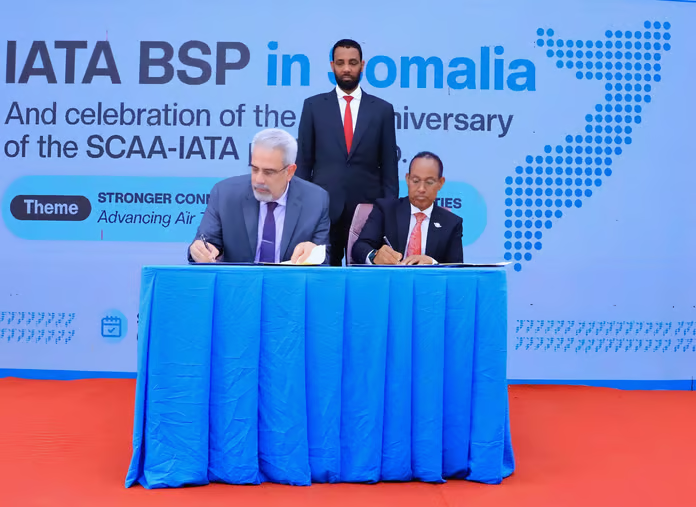
The relaunch, held in Mogadishu on October 18, 2026, was attended by Prime Minister Hamza Abdi Barre and senior aviation officials. It coincided with an agreement recognising IATA’s international safety audit programmes for airlines and ground-handling companies, marking two developments in the country’s efforts to strengthen its aviation infrastructure and regulatory framework.
For Somalia’s travel trade, the return of BSP provides a mechanism through which IATA-accredited travel agents can report ticket sales and settle payments with participating airlines through a centralised system rather than managing separate settlement arrangements with individual carriers.
The system could reduce administrative work, improve reconciliation of ticket revenues and give airlines greater visibility over sales and payments in the Somali market. Its commercial value will depend on participation by airlines and accredited agencies, as well as the financial and operational arrangements supporting its implementation.
IATA announced a pilot programme on April 30, 2026, involving four travel agencies and several airlines serving Somalia, including Ethiopian Airlines. At the time, the association said it intended to open the system more widely, targeting more than 300 travel agents operating in the country.
The October relaunch marks the formal return of the settlement system after decades without a domestic BSP arrangement. However, the number of agencies and airlines actively participating following the relaunch has not been publicly confirmed.
A US$242 billion global settlement system
The scale of IATA’s global settlement operations illustrates the importance of the infrastructure being restored in Somalia.
In 2025, BSP processed more than 700 million transactions across over 180 countries, with a total value of US$242 billion, according to IATA. The system serves hundreds of airlines and tens of thousands of travel agents worldwide.
BSP consolidates ticket sales reporting and payments, allowing agents to submit sales information through a central mechanism from which payments are distributed to participating airlines. It also supports the administration of refunds, billing adjustments and other ticketing-related transactions.
For travel agencies, the arrangement can simplify financial reconciliation and reduce the administrative burden of dealing separately with multiple carriers. For airlines, it provides a standardised framework for collecting ticket revenue and monitoring sales through accredited distribution partners.
The system does not eliminate the need for financial controls or guarantee access to every airline. Participation, accreditation requirements and applicable settlement rules remain important conditions for agencies seeking to use it.
Somalia’s reinstatement also has implications for the relationship between local travel businesses and international carriers. IATA has identified the country’s diaspora and expanding trade links across Africa and the Middle East as factors supporting demand for air travel.
A more structured settlement framework could make it easier for participating airlines to work with accredited Somali agencies, although the extent of any resulting increase in bookings or airline capacity remains uncertain.
Safety audits recognised under national regulations
The BSP relaunch coincided with a memorandum of understanding signed on October 18 between IATA, Somalia’s Ministry of Transport and Civil Aviation, and the Somali Civil Aviation Authority.
Under the agreement, the regulator will recognise two IATA audit programmes as acceptable means of demonstrating compliance with national regulations: the IATA Operational Safety Audit (IOSA) and the IATA Safety Audit for Ground Operations (ISAGO).
IOSA assesses an airline’s operational management and control systems, while ISAGO examines the management systems and procedures used by ground-handling companies. Its scope includes passenger and baggage handling, aircraft ramp operations, load control, and cargo and mail handling.
The recognition is intended to support the use of internationally established audit standards and reduce duplication in compliance assessments. The programmes will complement, rather than replace, the Somali Civil Aviation Authority’s statutory safety oversight responsibilities.
The agreement was signed by Transport and Civil Aviation Minister Mohamed Farah Nuh, aviation authority director-general Ahmed Moallim Hassan, and IATA regional vice-president for Africa and the Middle East Kamil Alawadhi.
The arrangement forms part of IATA’s Focus Africa initiative, which identifies safety, infrastructure, connectivity, financial services, sustainability and workforce skills among the priorities for improving African aviation.
For airlines and ground-handling operators, acceptance of recognised audits may help streamline aspects of regulatory compliance. Its practical effect will depend on how the Somali regulator applies the agreement and the requirements individual operators must continue to meet.
Rebuilding aviation infrastructure
Somalia’s return to BSP comes amid broader efforts to restore national aviation functions following decades of institutional disruption.
In January 2023, Somalia resumed air traffic control services in high-altitude Class A airspace within the Mogadishu Flight Information Region after approximately three decades of disruption. The recovery involved improvements to aviation communications, navigation infrastructure and operational capacity.
The restoration of settlement services addresses a different part of the aviation system: the financial infrastructure connecting travel agents and airlines. Together with the recognition of international safety audits, it reflects efforts to strengthen the institutions and processes needed to support commercial air transport.
For Somalia’s travel businesses, the immediate priority will be translating the formal relaunch into reliable access to participating airlines, predictable settlement procedures and effective support for accredited agencies.
The BSP return alone does not establish how much additional ticket revenue will be generated, nor does it guarantee that all local agencies will be able to use the system. Those outcomes will depend on participation, implementation and the development of the wider aviation market.
Nevertheless, after 35 years without a domestic BSP arrangement, the relaunch restores an important link between Somalia’s travel trade and the global airline distribution system. The accompanying safety agreement adds a regulatory dimension to the effort, as the country seeks to strengthen both the commercial and operational foundations of its aviation industry.
Source: somalilandstandard.com